
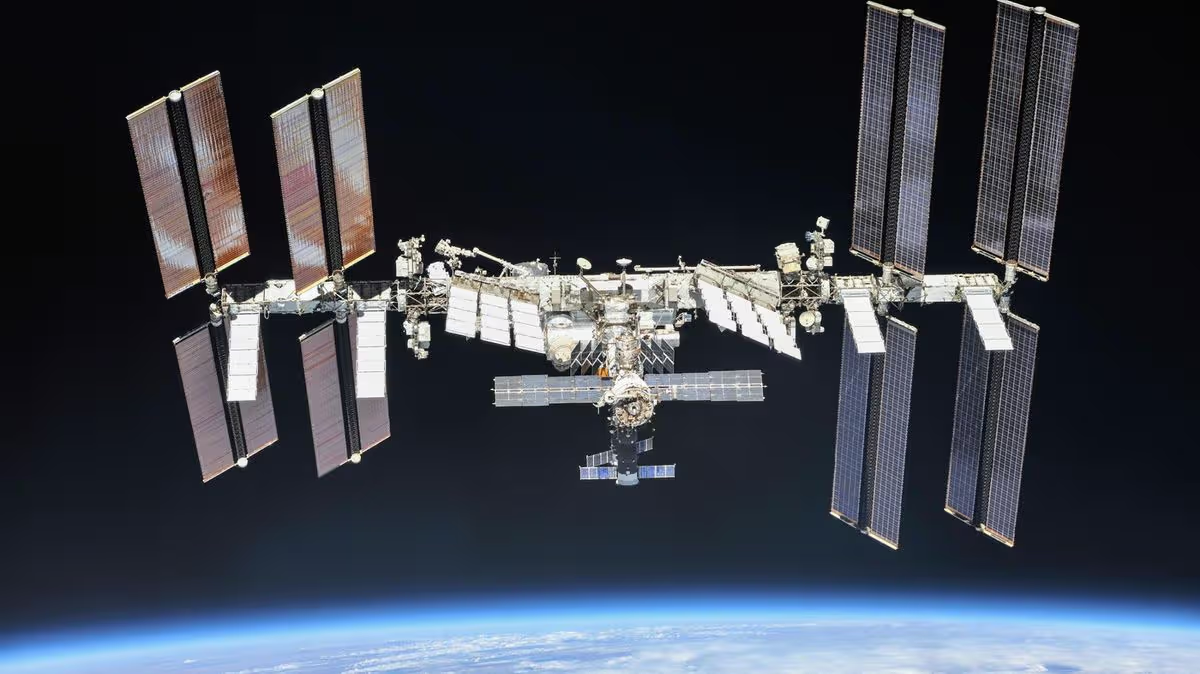
NASA is spending $1bn on a strategy to safely crash the leaking ISS into the Pacific Ocean by 2031 before it triggers a catastrophic uncontrolled fall
Time is officially ticking down for the International Space Station after a quarter-of-a-century in orbit. Fears for the iconic outpost reached boiling point just days ago when a worsening gas leak forced NASA crew members to brace for an emergency evacuation while Russian cosmonauts scrambled to try and patch the hole.
While the astronauts managed to avoid a midnight run back to Earth, the terrifying near-miss has sparked concerns that the ageing ISS is well past its sell-by date.
Space boffins have now unveiled the step-by-step blueprint to obliterate the doomed $100billion mega-structure and send it plunging into a watery grave.
Speaking at the ASCEND 2026 aerospace conference, Ryan Landon, director of Operations at NASA Johnson Space Centre, revealed the giant laboratory will begin its death spiral as early as 2028.
Weighing in at a colossal 450,000kg – the equivalent of 280 family cars – the ISS stays up by whizzing around Earth 16 times a day at a mind-boggling 17,500mph. Without constant thruster boosts, it would plunge into the atmosphere naturally.
But letting the massive base fall on its own would trigger an apocalyptic, uncontrolled re-entry, raining lethal shards of hot metal down on civilian populations.
Dr James Beck, space debris expert and director of UK-based space consultancy Belstead Research, told the Daily Mail: “It is certain that parts will reach the surface of the Earth, and most likely quite a lot of parts. The open question is how many, and whether there can be sufficient control over where this occurs.”
Boffins say that any space re-entry carries an internationally agreed “casualty risk limit” of one in 10,000, usually triggered by smaller satellites. The ISS is an entirely different beast.
Dr Beck said: “It should be expected that a few hundred objects which could cause casualties on the ground would be produced.”
To prevent a global catastrophe, NASA cannot stop the debris from forming, so they must control exactly where it lands.
The designated target is Point Nemo in the Pacific Ocean, a remote location known as the “Spaceship Graveyard,” because it is the furthest point from human life on Earth.
Slowing the space station down enough to hit this target will require nine tonnes of fuel, a feat far beyond the capability of the station’s existing thrusters. Enter billionaire Elon Musk.
NASA has handed SpaceX a contract worth just under $1 billion (£749.69 million) to build a powerful cosmic “tugboat.”
Musk’s team will modify a SpaceX Crew Dragon capsule, packing it with six times the fuel and four times the power of a standard vehicle to act as the ultimate executioner.
The final cargo ships will flee the station in 2029 before all operations officially shut down in 2030. Once the last crew says goodbye, the ghost ship will sink to 175 miles above Earth.
Dana Weigel, NASA’s ISS manager, previously explained that the SpaceX tug will deliver the final blow over several stages.
Ms Weigel said: “At the right time, it will perform a complex series of actions…over several days to deorbit the space station.
“First, the deorbit vehicle will perform orbit shaping burns to put the station in a low elliptical orbit, and then, eventually, it will perform a final re-entry burn.”
Even if the plan goes perfectly, up to 100 tonnes of scorched metal will survive the burn. Experts also fear the tug could lose control and begin a fatal tumble once it hits thick air 150 miles up.
It mirrors the 1979 disaster when NASA’s Skylab broke apart prematurely, raining wreckage over Western Australia. Yet, space bosses insist doing nothing is not an option.
NASA’s official assessment concluded: “The International Space Station requires a controlled re-entry because it is very large, and uncontrolled re-entry would result in very large pieces of debris with a large debris footprint, posing a significant risk to the public worldwide.
“Ensuring the space station is well maintained continues to be the safest operational approach while also planning for deorbit at the space station’s end of life.”
By staronline@reachplc.com (Liam Randall)
Source link