
NEWYou can now listen to Fox News articles!
A medieval letter from a notorious French king has been discovered in an unusual location: a Canadian library.

The 15th-century letter, identified by researchers at the University of Toronto’s Old Books New Science Lab, was sent from the court of Louis XI, also known as the “Spider King.”
Louis XI, who ruled from 1461 until his death in 1483, is best known for strengthening the French government after the Hundred Years’ War.
ANCIENT MONASTERY FROM EARLIEST CENTURIES OF CHRISTIANITY UNEARTHED AT DESERT SITE
He’s also known for his political maneuvering — which involved espionage and secret alliances.
The University of Toronto announced the find in a press release earlier this year. It had been sitting unrecognized in the binding of a book in the Robertson Davies Library at Massey College, an independent college affiliated with the University of Toronto, for years.
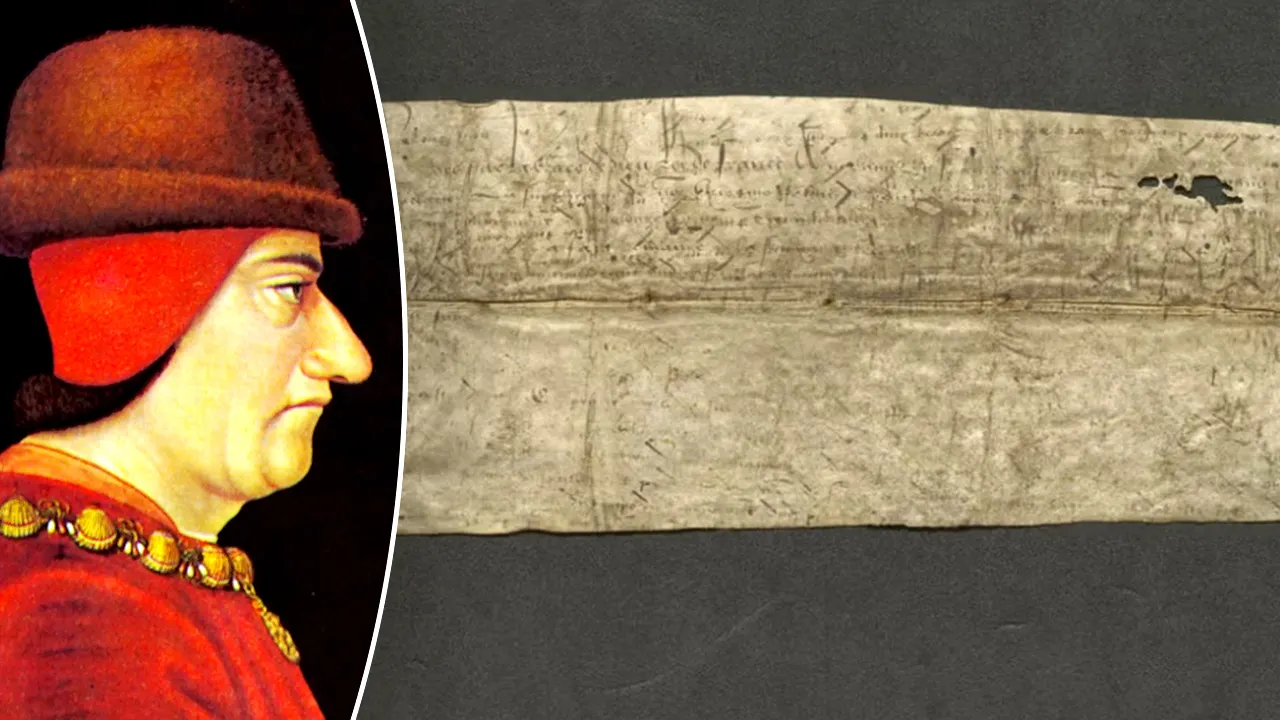
A rare 15th-century letter from the court of Louis XI was recently identified in a Canadian library collection after going unnoticed for years. (adoc-photos/Corbis via Getty Images; Andrews Project for Book Science)
The missive was identified by researchers Jessica Lockhart and Chana Algarvio during a closer examination of the fragment using advanced imaging.
They brought it to Sebastian Sobecki, a professor of medieval English literature at the University of Toronto, for identification.
TEST YOURSELF WITH OUR LATEST LIFESTYLE QUIZ
Images show the artifact yellowed and frayed with age, covered in small text written in dark ink.
The fragment was likely recovered during a 20th-century book restoration after passing through a family of collectors, said Chana Algarvio, assistant librarian at Massey College and a Ph.D. student at the University of Toronto.

The letter, linked to King Louis XI of France, was found embedded in the binding of a later printed book. (Universal History Archive/Universal Images Group via Getty Images; Andrews Project for Book Science)
Algarvio told Fox News Digital it was donated by a man named Will Rueter, who inherited it from his great-uncle Georg Rueter.
“According to Will, Georg frequented bookstores his whole life and particularly favored the bookseller stalls at the University of Amsterdam,” she said.
CLICK HERE TO SIGN UP FOR OUR LIFESTYLE NEWSLETTER
“Due to the fragment’s small size, it probably came to Georg via his bookbinder friends or his daughter, who was trained as a bookbinder.”
The discovery’s significance lies in its rarity, said Sobecki.
“Identifying these fragments relies on a combination of tools, including language, handwriting and document format.”
“Finding parts of medieval manuscripts in book bindings is common, but finding royal letters or charters in such places is very rare,” he told Fox News Digital.
“Identifying these fragments relies on a combination of tools, including language, handwriting and document format.”
CLICK HERE FOR MORE LIFESTYLE STORIES
He also described the letter as a lettre patente, or a formal royal decree issued by a monarch.
These documents “were really important to the making of the modern French bureaucracy,” he noted.

Advanced imaging technology helped researchers recover details from the faded parchment and ink. (University of Toronto Libraries)
And for those wondering why Louis XI was called the “Spider King,” it’s because he wove a vast network of political intrigue and royal control — like a web.
“Louis was exceptionally adept at political intrigue and [at] using the royal administration effectively to this effect,” Sobecki noted.
CLICK HERE TO GET THE FOX NEWS APP
“He also professionalized the government by appointing bureaucrats rather than hereditary aristocrats, laying the foundations of the political and legal unification of France.”
By Andrea Margolis
Source link