Frequently asked questions
Are drugstore sunscreens comparable to luxury sunscreens?
Yes. “There are actually many excellent drugstore sunscreens that can be comparable to ‘luxury’ products,” says Dr. Weiser, noting that most of the products he recommends to patients are drugstore brands, not luxury ones. Joel Spitz, MD, a board-certified dermatologist and Chief Medical Officer at Honeydew, agrees that price isn’t the right lens to look through at all. “I don’t actually think in terms of drugstore versus luxury—that’s not the right framework,” he says. “A drugstore sunscreen with zinc oxide and titanium dioxide is going to outperform an expensive luxury sunscreen loaded with chemical filters every time in my book.” In other words: you’re not compromising protection by shopping the drugstore aisle—you’re just skipping the markup. What matters more is the level of protection and skin barrier-supporting ingredients.
What should you look for in a drugstore sunscreen?
“The most important factor to look for is broad-spectrum coverage,” says Dr. Weiser, meaning protection against both UVA (aging, pigmentation) and UVB (burning) rays. From there, SPF matters too—aim for at least 30, though many derms prefer 50 for daily use. Water resistance (either 40 or 80 minutes) is another key detail, especially if you’re sweating or spending time outdoors, since that determines how often you need to reapply.
Beyond that, it gets more personal. Dr. Guo says he focuses less on brand names and more on whether a sunscreen actually works for someone’s routine. “If they don’t like how it looks, smells, or feels, there is a high likelihood of noncompliance with usage,” he says. In other words, the best sunscreen is the one you’ll consistently wear, whether that’s a lightweight fluid, a glowy primer, or a matte finish that keeps oil in check. Dr. Spitz also points out that tinted formulas can be especially helpful, since iron oxides offer additional protection against visible light, which plays a role in hyperpigmentation.
Are mineral or chemical sunscreens better?
It depends. “The best sunscreen is the one you like enough to use every single day of the year,” says Dr. Weiser. Both mineral (zinc oxide, titanium dioxide) and chemical sunscreens offer effective broad-spectrum protection, but they feel very different on the skin. Mineral formulas tend to sit on the skin and are often better suited for sensitive or reactive skin types, while chemical sunscreens are typically lighter and easier to blend, especially on deeper skin tones.
Dr. Guo echoes that both are safe and effective, but notes that format can matter just as much as the filters themselves. “Liquid sunscreen is better than any other form of sunscreen,” he says, since it’s easier to apply evenly, while sprays and sticks are better reserved for reapplication or targeted areas.
Dr. Spitz, on the other hand, strongly prefers minerals. “The active ingredients zinc oxide and titanium dioxide are physical blockers that don’t penetrate the skin,” he says. “Chemical sunscreen filters have been shown to absorb into the bloodstream at measurable levels… and I’d rather not take that chance when excellent mineral alternatives exist.” Still, even he acknowledges the bigger picture: if a chemical sunscreen is the one you’ll actually use consistently, that’s ultimately what matters most.
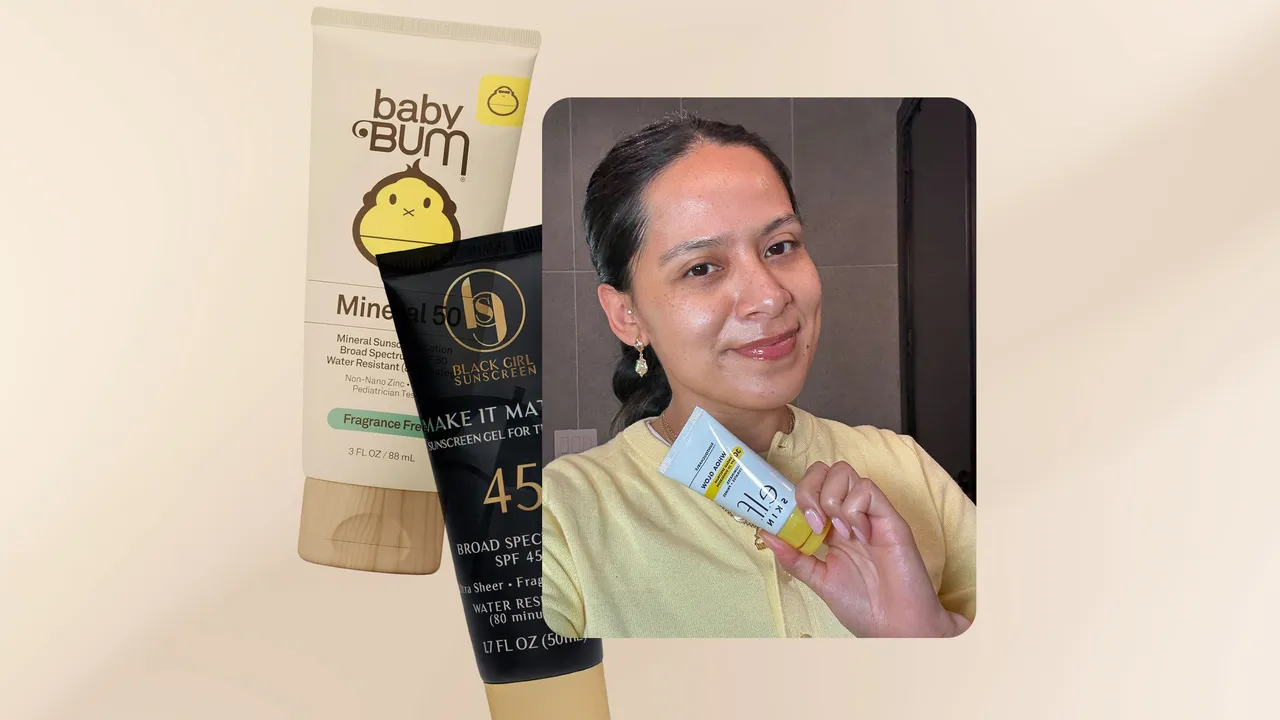
To find the best drugstore sunscreens, we tested formulas across a range of categories—mineral, chemical, sprays, sticks, and tinted options—paying close attention to how they performed in real-life routines.
We evaluated each product based on its active ingredients and level of protection (SPF and broad-spectrum coverage), as well as its texture and finish, whether that meant matte, dewy, or completely invisible on the skin. We also considered how well each formula layered with skincare and makeup, since pilling, greasiness, or white cast can be dealbreakers for daily use.
Finally, we prioritized ease of application and reapplication—because even the most effective sunscreen won’t do much if you’re not using enough of it, or reapplying it throughout the day.
- Joshua Zeichner, MD, a board-certified dermatologist and director of cosmetic and clinical research in dermatology at Mount Sinai Hospital
- Jessica Weiser, MD, a board-certified dermatologist and founder of Weiser Skin MD
- Danny Guo, MD, double-board certified dermatologist,
- Joel Spitz, MD, board certified dermatologist and Chief Medical Officer at Honeydew
- Neera Nathan, MD, a board-certified dermatologist and fellowship-trained Mohs micrographic surgeon in New England
By Hana Hong, Nykia Spradley
Source link