• The European Union’s three biggest economies — Germany, Britain and France — joined Ireland, Australia, Singapore, Malaysia and Oman in banning all Boeing 737 Max 8 planes from their airspaces on Tuesday. The decisions came two days after 157 people were killed on a Max 8 during a flight from Addis Ababa, Ethiopia, to Nairobi, Kenya, and could cause considerable disruption to global air travel.
• At least 27 airlines have now grounded the Max 8, which has crashed twice in five months. Boeing stands by the airworthiness of the jet, but it said it planned to issue a software update and was working on changes to its flight controls and training guidelines following the first crash, of a Lion Air flight in Indonesia last October.

[Read about how the airplane maker is dealing with the fallout from the crash.]
• Pressure escalated inside the United States for a grounding of the Max 8, despite the Federal Aviation Administration’s declaration on Monday that the plane was considered safe. The union representing flight attendants at American Airlines, a heavy Max 8 user, urged management to “strongly consider grounding these planes until a thorough investigation can be performed.”
• President Trump, weighing in for the first time, posted Twitter messages deploring what he described as the technological complexities of commercial aircraft. “Pilots are no longer needed, but rather computer scientists from MIT,” Mr. Trump said. Much of what he asserted, however, was misleading or lacked context, aviation experts said.
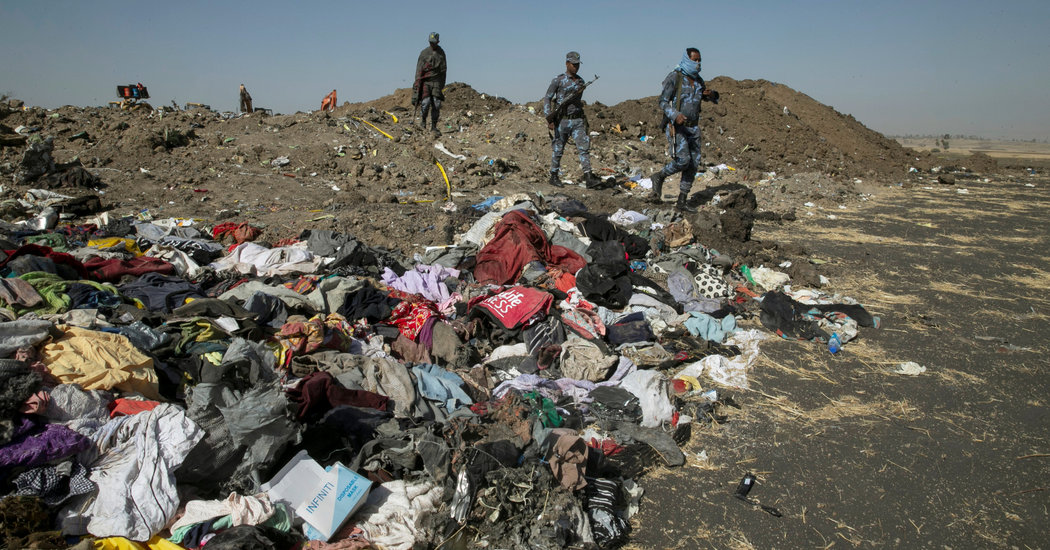
• Investigators from the United States and elsewhere are at the crash site of Ethiopian Airlines Flight 302. Much of the investigation will focus on the so-called black boxes, voice and data recorders that were recovered on Monday. The airline’s chief executive, interviewed by CNN, said the pilots had told air traffic control they were having “flight control problems.”
Big E.U. countries join the ban on 737 Max 8s
As the list of airlines taking their 737 Max 8 aircraft out of service continued to grow, France, Germany, Britain, Ireland, Australia, Singapore, Malaysia and Oman joined China and Indonesia in suspending all use of the plane.
France and Germany, which lie in the heart of Europe, took the step shortly after Britain did so. “Safety has absolute priority,” Andreas Scheuer, Germany’s transport minister, said in an interview on the N-TV news channel.
France’s civil aviation authority said in an announcement posted on Twitter that it was taking the step even though no French airlines operate the Max 8.
The U.K. Civil Aviation Authority said it had, as a precautionary measure on the Max 8, “issued instructions to stop any commercial passenger flights from any operator arriving, departing or overflying U.K. airspace.” The agency said its decision affected at least five 737 Max 8s that have been registered and are operating in the country.
The decision affected TUI Group, a British-German holiday tour company that operates the affected planes. The company, which flies vacationers on package holidays in the Mediterranean, could not immediately confirm how many flights or passengers would be affected.
The British decision also affected Norwegian Airlines, which said it would stop flying its 18 Max 8s until further notice. Norwegian, which uses Max 8s between East Coast American cities and Western Europe, acknowledged that the suspension would lead to flight delays and cancellations.
Singapore’s decision will affect Silk Air, a Singapore-based airline with six of the planes, and four other airlines that operate the aircraft in the country.
After Silk Air grounded its planes, Fiji Airways was the only carrier still operating the aircraft in Australia. Fiji Airways said on Tuesday — before Australia’s announcement — that it intended to continue flying its two planes and had “full confidence” in their safety, according to the Australian Broadcasting Corporation.
Also on Tuesday, Eastar Jet of South Korea grounded its two Max 8 jets.
In the days since the crash, many airlines have opted to ground the planes out of caution. Four additional airlines — Aeroméxico, Aerolíneas Argentinas, Gol of Brazil, MIAT Mongolian Airlines and Royal Air Maroc of Morocco — took the planes out of service on Monday.
At least 18 airlines were still flying the jet on Monday, including Southwest Airlines, American Airlines and Air Canada.
Grounding a fleet because of technical problems is rare. The F.A.A. hasn’t done it in the United States since 2013, when a problem with the Boeing 787’s battery system was discovered.
Pilots reported ‘flight control problems,’ airline C.E.O. says
The pilots of Ethiopian Airlines Flight 302 reported to air traffic control that they were having “flight control problems” in the moments before the crash, the airline’s chief executive was quoted as saying in an interview with CNN.
The quoted remarks from the chief executive, Tewolde GebreMariam, suggested the plane was not responding to actions by the pilots.
Mr. GebreMariam was also quoted as saying the black boxes recovered from the wreckage “will be sent overseas” and not analyzed in Ethiopia. He did not specify where they would be taken.
American Airlines flight attendants ask for a halt in Max 8 flights
The president of the Association of Professional Flight Attendants, Lori Bassani, said members were “very concerned with the recent Ethiopian Airlines Flight 302 crash, which has raised safety concerns with the 737 Max 8.”
In a statement, she said the association, which represents flight attendants at American Airlines, was calling on its chief executive, Doug Parker, to “strongly consider grounding these planes until a thorough investigation can be performed.”
While she did not say flight attendants would refuse to fly on the Max 8, “our flight attendants will not be forced to fly if they feel unsafe.” American Airlines operates 24 Max 8s, making it one of the largest users of the plane in the United States.
‘I don’t want Albert Einstein to be my pilot,’ says Trump
President Trump lamented what he described as excessive technology that has overtaken modern commercial jet travel and made it, in his view, more dangerous.
Without specifying Boeing or the Max 8, Mr. Trump said aircraft had become “far too complex to fly,” and recalled approvingly the era when pilots had total control in the cockpit.
“Split second decisions are needed, and the complexity creates danger,” Mr. Trump said in a pair of postings on Twitter. “All this for great cost yet very little gain. I don’t know about you, but I don’t want Albert Einstein to be my pilot. I want great flying professionals that are allowed to easily and quickly take control of a plane!”
While the president may share the concerns of many fliers, pilots and aviation experts agree that new technologies have made the industry safer than ever. There are far more automated functions in flight, but pilots still take manual control during critical stages like takeoffs and landings, and are necessary to control the technology in the cockpit and serve as backstops if malfunctions arise.
Concerns have arisen that pilots are not familiar enough with the latest technology in planes, an issue raised after the crash of the Lion Air flight last October — the same model of Boeing plane as in the Ethiopian crash. Still, fatal airline accidents have fallen, and in the United States are the lowest in aviation history. Since 2009, there has been only one passenger fatality on flights operated by United States airlines.
Boeing plans changes to plane’s control systems
Boeing is negotiating with the Federal Aviation Administration over improvements to its 737 Max 8 after the aircraft’s second crash in five months, though both the government and company insist the plane is safe to fly as is.
Since October, when a Max 8 belonging to the budget airline Lion Air crashed in Indonesia soon after takeoff, killing all 189 people on board, Boeing has been working on changes to the flight control systems of the aircraft. The company has also been updating its training guidelines and manuals so that airlines can teach their pilots to fly the planes more safely and easily.
After the crash of Lion Air Flight 610, concerns arose about the aircraft’s flight control systems. The main changes now being developed to those systems include limiting how much the plane’s computers can automatically pull down the nose of the plane if sensors detect a stall.
The concern after the Lion Air crash was that erroneous readings from poorly maintained sensors in the nose of the plane might have fooled the automatic systems into detecting that the plane was traveling sharply upward and in danger of stalling, when it was actually in level flight. The automatic systems may then have forced the nose down significantly, sending the plane into a steep dive into the ocean.
Boeing issued a statement late Monday saying that since the Lion Air crash, the company had been developing a “flight control software enhancement for the 737 Max, designed to make an already safe aircraft even safer.” According to the company, it has been working with the F.A.A. to roll out the software updates across the 737 Max fleet in the coming weeks.
Boeing stock price takes another hit
Share prices of Boeing, a major component of the Dow Jones industrial average, fell 5.7 percent in early trading on Tuesday, following a similar decline Monday on worries about the spreading impact of the Max 8 crash in Ethiopia and the prognosis for future sales of the plane.
Discovery of black boxes first step to revealing their data
The flight data and cockpit voice recorders of Ethiopian Airlines Flight 302 were recovered on Monday, but the process of extracting the data contained within the so-called black boxes could be lengthy, experts cautioned.
The two recorders will need to be taken to a specialized center to read their data, said Lynnette Dray, an aviation expert and senior research associate at University College London.
Malaysia suggests it could cancel 737 Max 8 orders
More than 130 planes have been grounded worldwide in recent days, but there are hundreds more that have been ordered from Boeing, whose fates are now less certain.
Malaysia’s economic affairs minister said on Monday that the country’s sovereign wealth fund should review an earlier purchase agreement for 25 of Boeing’s 737 Max 8 planes, putting those orders in jeopardy.
Boeing’s 2016 agreement with Malaysia Airlines — an embattled, state-owned carrier — was valued at $2.75 billion at list prices and included purchase rights for additional 737 Max 8 and 737 Max 9 aircraft.
“They have to revisit whatever agreements that they had in the past,” the minister, Datuk Seri Mohamed Azmin Aliwas, told reporters, referring to the sovereign wealth fund, called Kazanah.
No other airlines have publicly questioned their orders of Boeing Max aircraft in the wake of the Ethiopian Airlines crash, said Shukor Yusof, the founder of Endau Analytics, an aviation consultancy based in Malaysia and Singapore.
Kazanah’s backtrack on the orders may have less to do with safety and more to do with money and politics, Mr. Yusof said, adding that the airline has been plagued by steep losses since 2014. Additionally, he said, the government of Prime Minister Mahathir Mohamad, which came to power last year, is aware that the citizens are currently skeptical of spending from government coffers.
On Tuesday, Mr. Mahathir said he was weighing whether to invest more in the airline, or perhaps even sell it or shut it down. “All these things are open for the government to decide,” he said. “We have to decide soon.”
Another major buyer of the Max jets in Asia is VietJet Air, a private Vietnamese airline that recently purchased 100 Boeing 737 Max jets worth nearly $13 billion at list prices.
On Monday, Dinh Viet Thang, the chairman of Vietnam’s Civil Aviation Authority, said that while the first Boeing Max planes were scheduled to be delivered in the country in October, they would not receive licenses for local use until the causes of the Max 8 crashes were identified and the F.A.A. took “proper remedying measures.”
By THE NEW YORK TIMES
Source link