
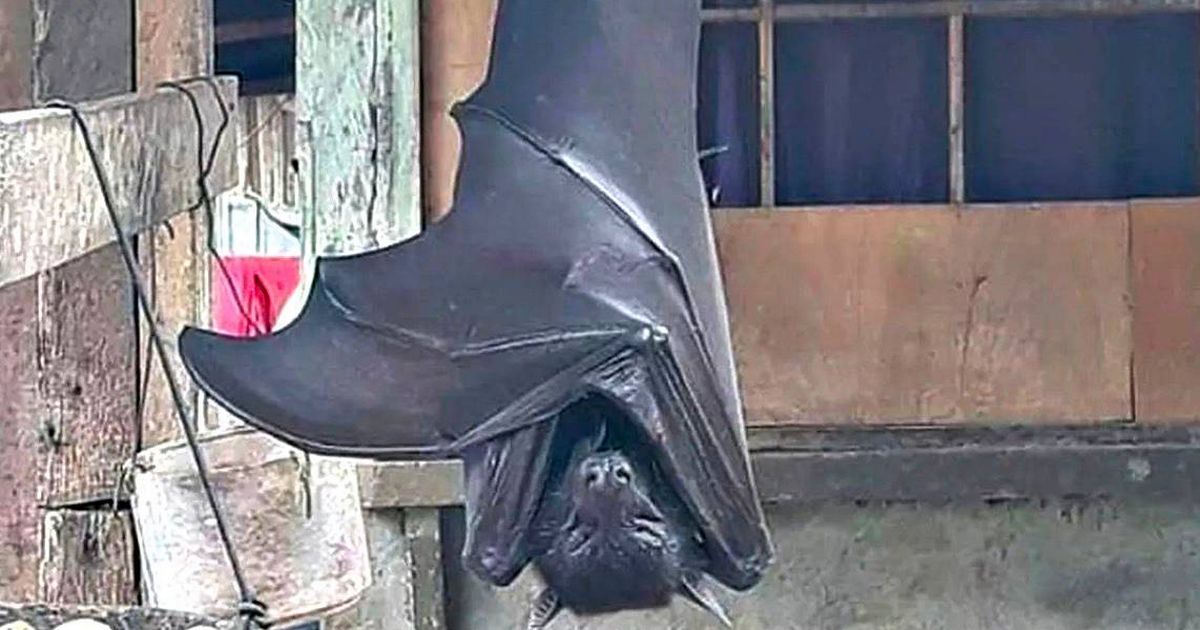
The giant golden-crowned flying fox, also known as the golden-capped fruit bat, is thought to be the largest bat species on the planet with a wingspan of up to 1.7m
A colossal bat that became an internet sensation due to its remarkable size “doesn’t shy away from humans” and boasts a peculiar neck-biting mating ritual.
The giant golden-crowned flying fox, alternatively called the golden-capped fruit bat, is believed to be the world’s largest bat species, boasting a wingspan reaching up to 1.7m but faces potential extinction.
A photograph of this massive creature recently re-emerged on social media, leaving online users utterly bewildered. The X (formerly Twitter) post displaying the animal with its wings enveloping its “human-sized” frame went viral, with users rushing to share their thoughts on the image. One commented: “Holy mother. It’s Batman the size of a man.”
Another user declared they would “leave the country” if forced to coexist with these enormous bats. Thankfully for the anxious X user, these creatures inhabit exclusively the jungles of the Philippines and couldn’t possibly survive in Britain’s countryside.

Frankie Hobro, Director of Anglesey Zoo, explained to the Daily Star: “This species could not survive in the wild anywhere in the UK as it requires tropical temperatures to survive and it feeds on large quantities of ficus fruits which cannot grow here.”
She noted the bat ranks as the third-heaviest bat species, tipping the scales at 1.4kg. “Their sheer size makes them genuinely nightmarish to many, but in fact while their wingspan is wide, this bat’s body is small – about the size of a small dog,” Hobro continued.
“This bat doesn’t shy away from human activity and they can be found in forests near populated villages or towns, provided the laws against hunting them are adhered to and industrial activity is minimal, but disturbance and high hunting activity sees these animals retreat to thickly wooded forests to roost on inaccessible slopes more than 1000m above sea level.”

Whilst these winged mammals may gravitate towards human settlements, they pose little danger to people. As plant-eaters, they survive on a diet of figs, fruits and foliage.
Yet their courtship behaviour bears an eerie resemblance to vampire folklore. “The mating process often takes place at night, with the male bat awakening the female by biting her on the neck and then initiating copulation,” Hobro continued.
“If copulation occurs during the day, the male will initiate sex by rubbing its head against the female.

“And unsurprisingly, mating occurs whilst upside down. Bats are promiscuous animals and males and females will often copulate with many different partners, whom they often won’t encounter again.”
Tragically, these formidable-looking creatures face extinction. Hobro explained that habitat destruction and commercial hunting have led to declining population numbers.
They do present one risk to humans – the potential transmission of diseases. “Though they are generally harmless, it is possible for them to carry and transmit diseases to humans,” Hobro said.
“However, if they are left alone, it’s highly unlikely that bat-to-human infection would occur and this is another reason for these animals to be left undisturbed.”
By staronline@reachplc.com (Lizzie McAllister, Tom McGhie)
Source link