
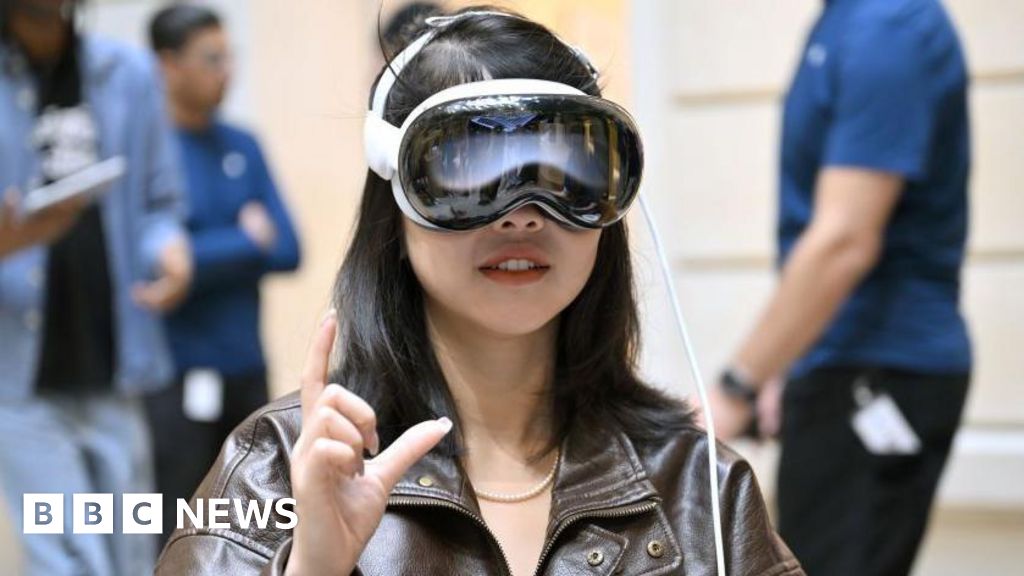
Apple and Meta are the two big players but VR is a crowded market – there are dozens, maybe hundreds, of different headsets already out there.
But what unites them all is none have quite hit the mainstream.
Up until now, the Vision Pro has only been on sale in the US – research firm IDC predicts it will shift fewer than 500,000 units this year.
Meta, which has been in the market longer, does not release sales data for the Quest either but it’s thought to have sold around 20 million worldwide.
VR headsets are nowhere near as ubiquitous as tablets, let alone mobile phones.
And it gets worse – George Jijiashvili, analyst at market research firm Omdia, said of those devices sold, many are abandoned.
“This is largely due to the limited in-flow of compelling content to keep up engagement,” he said.
But of course lack of content leads to reduced interest – and a reduced incentive for developers to make that content in the first place.
“It’s a chicken and egg situation,” Mr Jijiashvili told the BBC.
Alan Boyce, the founder of mixed reality studio DragonfiAR, warned that early adopters of the Vision Pro would have to “be patient” while more content arrived.
That’s where the Quest 3 wins out for him – it already has a “robust library” of games, and it can perform virtual desktop tasks just like the Vision Pro.
And IDC analyst Francisco Jeronimo says we should not be too quick to write off a slow start for Apple’s new product.
“There’s always the expectation that Apple with every single product will sell in the millions straight away, there’s always the comparison with the iPhone,” he said.
But the reality is even the iPhone took time to find its feet – and a huge number of buyers.
According to Melissa Otto from S&P Global Market Intelligence, the iPhone only became mainstream when the App Store “started to explode with apps that added value to our lives”.
“When people start to feel their lives are becoming better and more convenient, that’s when they’re willing to take the leap,” she said.
By
Source link