Ivanka Trump laid out her vision for the future of work and technology’s role in reshaping the American economy and workforce in the coming decades during a controversial ‘fireside chat’ at the Consumer Electronic Show (CES) on Tuesday.
Speaking the Venetian’s Pallazo Ballroom – which just a night prior had been used to launch a slew of new robots and artificial intelligence by Samsung – Trump chose to focus on the business implications of technology.
Trump said she had ‘no sympathy’ for companies that complain about unskilled workforces, don’t invest in ‘re-skilling them,’ and still lay off employees.
While the president’s daughter’s talking points centered mainly on business, she said she believes that innovations like ‘robotic arms’ would create jobs that aren’t yet possible.
Prior to her keynote, tech industry insiders hit out at the conference, questioning whether the White House advisor was a relevant speaker, but CES President and CEO, Gary Shapiro defended her presence and moderated her talk, entitled ‘The Path to the Future of Work.’
SCROLL FOR VIDEO

Ivanka Trump stressed the need for companies in general – and ostensibly the tech companies represented at the CES 2020 – to train their workers for increasingly high tech jobs


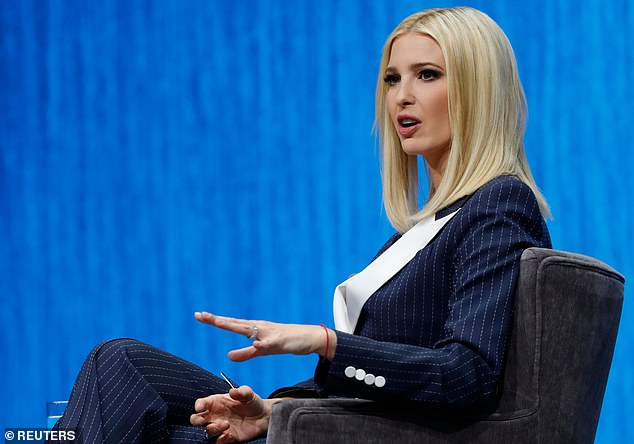
Dressed smartly in pinstripes (left), Trump said she has ‘no sympathy’ for employers who don’t ‘re-skill’ their workers as she laid out her ‘vision’ for the future workforce of the US and hit back at companies over layoffs
Trump plugged the government panel she co-chairs, the American Workforce Policy Advisory Board – which includes members from Apple, and IBM – and took the private sector to task for their role in helping to train current members of the workforce.
‘It’s not just about training for jobs of the future people need to think about investing in their current workforce so they can carry out the job of tomorrow,’ said Trump.
‘When I hear employers, they come to me and say ‘we need more skilled workers, we need more skilled workers’ and then I read about them laying off segments of the workforce because they were investing in productivity and not having spent the time…to take those workers and re-skill them…I really don’t have sympathy for that.’
Trump said that government programs have also lagged behind in their role of preparing future and current workers and espoused broader apprenticeship programs that have traditionally only focused on trade workers.

Smooth sailing into the future of business: Despite the criticism she faced, a nautically suited Trump received a warm round of applause at the conclusion of her keynote
‘That’s really my foremost passion and focus,’ she said, ‘removing obstacles for people who want and can work – to be able to provide for themselves and their families.’
‘The construction industry has a really strong apprenticeship program but few other sectors do,’ Trump claimed.
‘We need to keep the pipeline open.’
Depite most of the focus being on business, Trump did find time to talk more granularly about the ways technology can and should impact people for the better.
Specifically, Trump mentioned initiatives that would make personal data more accessible to the workforce – information like a high school diploma.
‘Why can’t you have your high school degree verified and in your phones so that an employer doesn’t need to call and find out did you in fact graduate,’ Trump said.

CES President and CEO Gary Shapiro (left) moderated Trump’s (right) keynote address and defended the Presidential adviser’s controversial presence at the tech conference

Turning her focus to data, Trump said that companies could leverage information on their employees to better match them with various positions, rather than hiring based on degrees


Trump promised that in the future there would be jobs that don’t exist today, thanks to ‘innovations like robotic arms’ that would enable some disabled people to do new tasks
That digitized information could also translate to other skills like CPR certfications, Trump said.
‘Maybe you learned CPR as a lifeguard, maybe you learned something [that] works on a factory floor,’ Trump said.
‘All of that should be catalogued and tracked and accessible and empowering the individual as opposed to locked up and siloed in the HR department of a company where if you leave it stays with them.’
Turning back to the role of technology in job-creation, Trump said that employers could use data on their employees to more easily market jobs to people and help members of the workforce find jobs that match their skills.
‘Oh by the way, wouldn’t it be great if there was a job vacancy in your zip code that matched the skill you have and it got pushed to you?’ Trump said.
‘This is not hard to do it just hasn’t been done.’
Trump noted that a more data-focused approach to hiring would, in her view, be an improvement upon one based mainly around degrees.

Toward the end of her keynote, Trump turned to women in tech, adding that she’s working with the White House to promote STEM education for women and girls
She pointed to IBM which was struggling to hire people for vacant cyber security jobs.
Though the company had requested that candidates have a bachelor’s degree in their listing, many candidates without a degree turned out to be equally as qualified as their college-educated competitors.
‘There really has never been a better time to be working in America than today. And there’s never been more Americans working than today.’
She also went over her work in the White House trying to gather support for new apprenticeship programs and K-12 programs focused on improving STEM education for the next generation of American workers.
Trump’s presence at the trade show had drawn advance criticism for her presence at the world’s biggest consumer technology trade show.
‘There are a lot of women who are doing a lot of work to help women in tech and build products that help women and help children and families,’ Sara Mauskopf, CEO of the childcare networking startup Winnie, told the Washington Post.
‘Ivanka Trump is not one of them.’
Rahat Rashid, an independent PR representative who frequently works with tech companies and startups was also critical.
‘It’s absolutely inappropriate,’ Rashid told Gizmodo, pointing to Trump’s lack of experience in the field.
‘I mean, she’s supposed to be representing women in tech and how is she actually a woman in tech? There should be someone else doing that.’
In spite of the controversy leading up to Trump’s keynote, the presidential advisor said that most of the policies and re-skilling initiatives should be common sense among workers, the private sector, and even across political aisles.
‘If we can’t come together on this, we can’t come together on anything,’ Trump said to a hearty round of applause.
By
Source link