TravelPerk, a business travel management platform targeted at SMEs, has raised $105 million in a fresh equity-based round of financing led by SoftBank’s Vision Fund 2.
Existing investors including Kinnevik and Felix Capital also participated in the round.
The funding gives TravelPerk a valuation of $1.4 billion, just a fraction over the $1.3 billion valuation the company revealed two years ago when it kicked of its Series D round — and that marginal increase seems to be a post-money valuation, meaning the valuation has remained flat. However, TravelPerk co-founder and CEO Avi Meir reckons that in a world where both funding and valuations have nosedived, a flat valuation isn’t all that bad.
“In today’s climate, where startup funding is down by half and valuations are down across the board, this is a healthy and sober valuation,” Meir told TechCrunch.
With the pandemic-driven travel slump just about a dot in the rear-view mirror, this has positioned companies such as TravelPerk a little more favorably than they perhaps were four years ago — travel tech startups raised at least $3.7 billion last year, a trend that seems to be filtering into 2024 with the likes of B2B travel app Tumodo announcing a $35 million raise last week.
Well-traveled
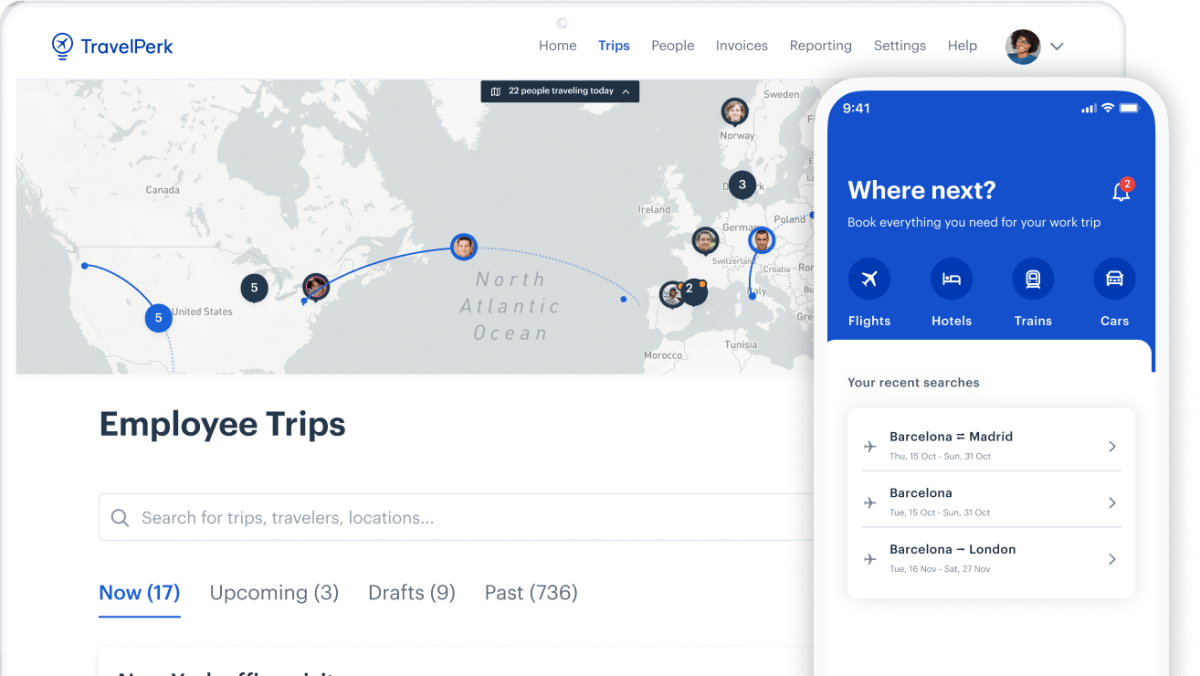
Founded in 2015, Barcelona-based TravelPerk sells an all-in-one platform for companies to book, manage, and report all their domestic and international travel. Customers can also extend the platform through integrations with expense management systems like Spendesk and HR software such as HiBob.
TravelPerk in action Image Credits: TravelPerk
TravelPerk had raised around $427 million before now, with the latest cash injection serving as the fourth instalment of a Series D round that kicked off back in 2021 with a $160 million investment consisting of debt and equity. The company added a further $115 million to the pot the following year in what it’s now calling a Series D-1 round, followed by a smaller $18.5 million extensio from existing investor Kinnevik six months ago in what might have been construed by outsiders as emergency capital — but that wasn’t the case, according to Meir.
“It was far from an emergency infusion — even without this round, we were already funded to break even,” Meir said, adding that last summer’s tranche was actually part of this latest investment.
“Tactically, we led with an anchor commitment from an existing investor and used that momentum to speak with some new investors that we had built relationships with over time,” Meir continued.
So all in, TravelPerk’s D-branded funding round weighs in at nearly $400 million, and the reason it has elected to call this an extension to the ongoing Series D round was due to the fact that it was raised on the same terms as that raised back in 2022.
TravelPerk also hadn’t previously revealed how much of its Series D round was equity vs. debt, but Meir has now confirmed to TechCrunch that it was roughly $80 million in debt.
Follow-on funding
There’s no escaping the fact that TravelPerk has somewhat bucked the broader trend that has seen many startups struggle to raise follow-on capital. But equally, it appears as though it has been burning through a lot of cash, though Meir is adamant that isn’t in fact the case, although it has been investing in its core product.
“It’s far from being spent — we have a significant cash position to provide flexibility for additional investment opportunities, and we were already fully funded to break even prior to this round,” Meir said. “The single largest investment is in our product and technology. Travel is a very complex category — aggregating a huge number of inventory providers, payment methods, and premium customer care functionality. It takes considerable product and engineering resources to do this well.”
This all brings us back to TravelPerk’s latest flagship investor — the mighty SoftBank, which has turned the world of venture capital on its head these past seven years. The Japanese investment conglomerate announced its second Vision Fund back in 2019, with limited partners including Microsoft, Apple, and Foxconn in tow. As with its previous fund, SoftBank invested in just about every technology vertical, but with the economic downturn and startup valuation “corrections” very much the order of the day, SoftBank recorded significant losses from its Vision Fund last year leading it to scale back its investments — for comparison, it made nearly 100 (known) investments in 2022, as per Crunchbase data, compared to less than 15 last year.
However, there were some signs it was getting its investment mojo back in the second half of 2023, and this latest cash injection into TravelPerk could be a sign that it’s about to ramp things up. In an interview with TechCrunch, SoftBank investor Stephen Thorne — who now gains a seat on TravelPerk’s board of directors — said that there were a multitude of reasons they decided to lead on this round. These include all the usual reasons around things like addressable market size, as well as the company’s growth — it claims a revenue spike of 70% in 2023, with a gross profit north of 90%.
But more than all that, Thorne said they looked at the company’s response to the global pandemic, in that they avoided major layoffs and continued to roll out new products — which is indicative of the broader company culture and how it’s built around Meir.
“Their execution through the Covid period was very impressive, and it was obviously a challenging time for travel startups,” Thorne said. “Their ability to come out of that stronger I think is a great validation of what he [Meir] has been able to build around himself. They’ve had a really measured and deliberate approach towards sustainable growth.”
What’s next for TravelPerk is anyone’s guess, but Meir already has a previous exit to his name in the form of Hotel Ninjas, which he sold to Booking.com parent Priceline in 2014. And it’s also worth noting that TravelPerk hired its first CFO in 2022, someone who previously led two other tech companies through an IPO.
“[An] IPO has never been an objective per se for TravelPerk,” Meir said. “Our aim is to build a company that will be here in 100 years. Whether we’re private or public, matters less. If and when we’ll make a decision to go public, we’re confident that we’ll be ready.”
By Paul Sawers
Source link