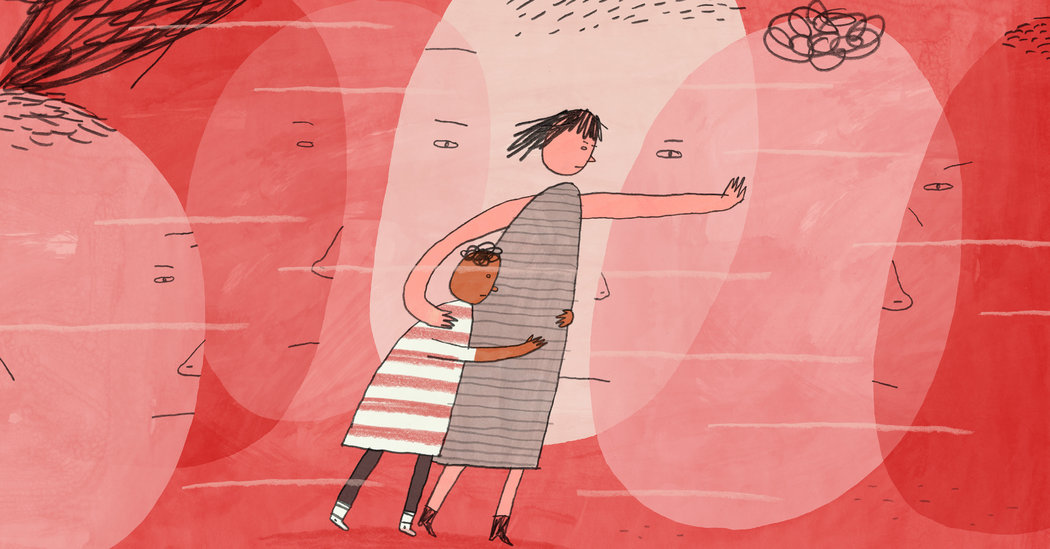
My son is biracial. His father is Haitian-American and I’m of Chinese descent; Often, I have to work to prove that my son is mine. On our daily subway commute to school, at least one person will look at me, then at him, and then back again. I am forced to see what they see: His skin is darker and his hair wavy, while I’m fair, prone to freckling, with hair that won’t hold a curl. If their eyes happen to meet mine, they’ll catch me glaring, holding them accountable for what I deem to be their silent judgment.
Perhaps I’m too hard on these strangers who wonder about the people before them, a mother and child reflected in a train window, one holding the other’s hand. But my own judgment has roots, too, and each time I face a stranger’s gaze, I’m forced to confront them anew.
Ten years ago, I stood alone at a Chinese banquet after my stepfather’s funeral, deciding where to sit. I was seven months pregnant with my son and hadn’t told my family, but I knew that my expanding waistline would elicit questions. After contemplating which relatives would be least likely to grill me, I wound up sitting with my mother, who offered me her silence.
I was unmarried and close to giving birth: the worst outcome in Chinese tradition. I knew my mother was disappointed, but I felt elated. I had dreamed of my son for years, envisioned the joy his existence would offer. I imagined the weight of his milk-scented body on my chest, him sleeping there as we breathed, exhausted but so in love.
At the banquet, I ate soup without tasting it, swirling bits of scallion in the broth. My partner, Claude, was waiting at home, cleaning the apartment in preparation for the months ahead. He offered to accompany me to the funeral, but I told him I wanted to go on my own to avoid questions about us, though I didn’t explain what that meant.
By TINA CHANG
Source link