Image copyright
Getty Images
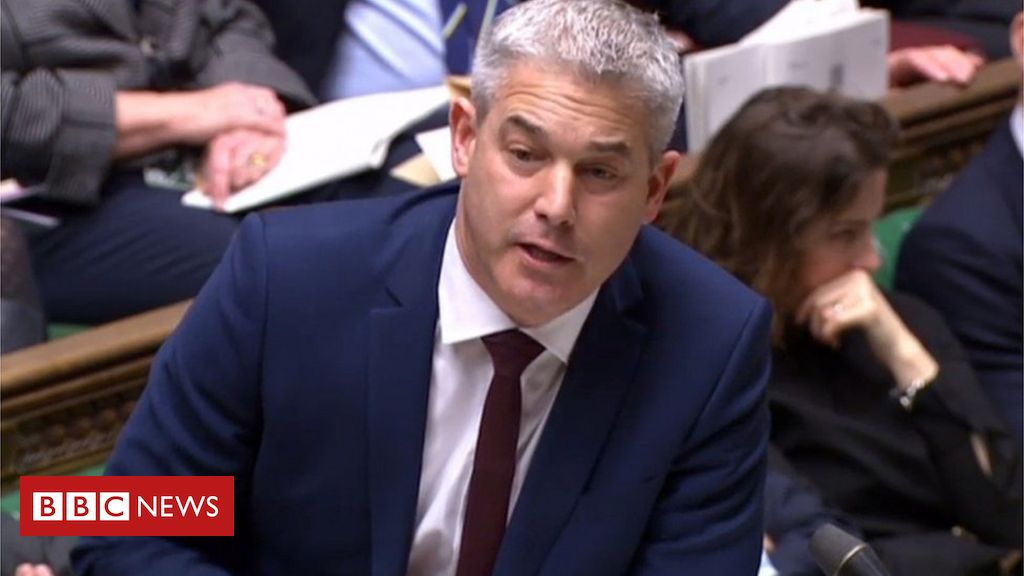
Brexit Secretary Stephen Barclay insists “no-deal’s is still a possibility
Brexit Secretary Stephen Barclay has come under fire for refusing to rule out a no-deal Brexit.
MPs will vote later on whether they still support the government’s approach that they backed in a vote last month.
Brexiteers are unhappy with the motion because they say it implies support for ruling out a no-deal Brexit.
But Remainers were annoyed when Mr Barclay confirmed that the government has not taken no-deal off the table when the UK leaves the EU on 29 March.
MPs will be asked to back a government motion which says the House of Commons “reiterates its support for the approach to leaving the EU to leaving the EU expressed by this House on 29 January 2019”.
But that has angered some Tory Brexiteers as MPs backed two motions on 29 January – one seeking an alternative to the controversial “backstop” element of the withdrawal deal and another one backing for a separate move to stop Brexit happening without a formal deal.
Downing Street has urged them not to rebel over what it describes as an “anodyne” motion.
It has warned it could damage the prime minister’s negotiating position, as she seeks to make changes to the controversial backstop “insurance policy” in the deal to avoid customs checks between Northern Ireland and the Republic of Ireland.
During Thursday’s debate, former Brexit secretary David Davis urged Mr Barclay to be “clear” about whether or not there is a deal, the UK would still be leaving the EU on 29 March.
The Brexit Secretary confirmed that it would but was challenged by Lib Dem MP Tom Brake about why he was respecting one Commons vote, but not the other.
Mr Barclay replied that the Commons “has said two different things” and had also passed legislation to say the UK would leave the EU on 29 March, “by a large margin” adding: “The legislation frankly takes precedence over that motion.”
Media playback is unsupported on your device
Ms Greening, a former education secretary who backs another EU referendum, described this approach as “fundamentally wrong and anti-democratic”.
Fellow Conservative Dame Caroline Spelman said “equal respect” must be given to both Commons motions adding: “If he fails to do that, it is contemptuous of this House.”
And Father of the House Ken Clarke said it was “ridiculous” to stick with the “arbitrary” 29 March departure date if no deal was in place.
But DUP Westminster leader Nigel Dodds said taking “no deal” off the table would weaken the UK’s negotiating position: “So those who call for no deal to be taken off the table are actually playing into the hands of the possibility of a no deal.”
Could Brexit cause a Labour split?
You’ll be used to people in my kind of job saying things like, “these are critical days”.
And hands up, on many of the occasions when a big move is predicted, a damp squib often comes along to squelch the expectation.
What I’m about to say may well be a repetition of that familiar phenomenon. But I’m not the only person in Westminster this week to be wondering whether after many, many, many months of private conversations where this possibility was discussed, in the next couple of weeks, maybe even in the next couple of days, something that actually is critical is going to start happening.
Mr Barclay also said the government’s priority was still to secure a deal and said: “The only way to avoid ‘no deal’ is either to secure a deal on the terms the prime minister has set out… the only other option would be to revoke Article 50 (the process by which the UK will leave the EU).”
For Labour, Sir Keir Starmer said the prime minister was “pretending to make progress while running down the clock”.
“A non-update every other week to buy another two weeks of process, inching ever closer to the 29th March deadline in 43 days,” he said.
“We should not be fooled.”
He expressed anger at the “macho way” some Brexiteers talked about “marching off the cliff” without a deal and said he would “take whatever steps are necessary” to avoid a no-deal Brexit.
Please upgrade your browser

Earlier, backbench Tory Brexiteer Bernard Jenkin told the BBC he had not yet decided how to vote but described the government motion as “gratuitously divisive”.
“If they are ramping it up and saying it’s going to blow the government’s negotiating position out of the water – they are obviously saying it is not anodyne.”
The government expects to be defeated if Conservative Brexiteers from the European Research Group vote against the motion and has warned that the EU will conclude that Theresa May cannot command a stable majority and there is no point making further concessions in negotiations.
MPs will also vote on have tabled amendments from Labour, the SNP and Tory backbencher Anna Soubry setting out alternative plans.
The UK is due to leave the EU on 29 March, whether or not a deal has been approved by the Commons.
Mrs May is continuing to try to get a Brexit deal through Parliament, after MPs rejected it by a historic margin in January. The prime minister says she is seeking legally-binding changes to the controversial “backstop”.
What happens next?
The prime minister has promised to return to the Commons on 26 February with a further statement – triggering another debate and votes the following day – if a deal has not been secured by that date.
If a deal is agreed, MPs will have a second “meaningful vote”, more than a month after Mrs May’s deal was rejected in the first one.
The EU has continued to say it will not renegotiate the withdrawal agreement.
On Wednesday, European Council President Donald Tusk tweeted that “no news is not always good news”, saying the EU was “still waiting for concrete, realistic proposals from London”.
By
Source link