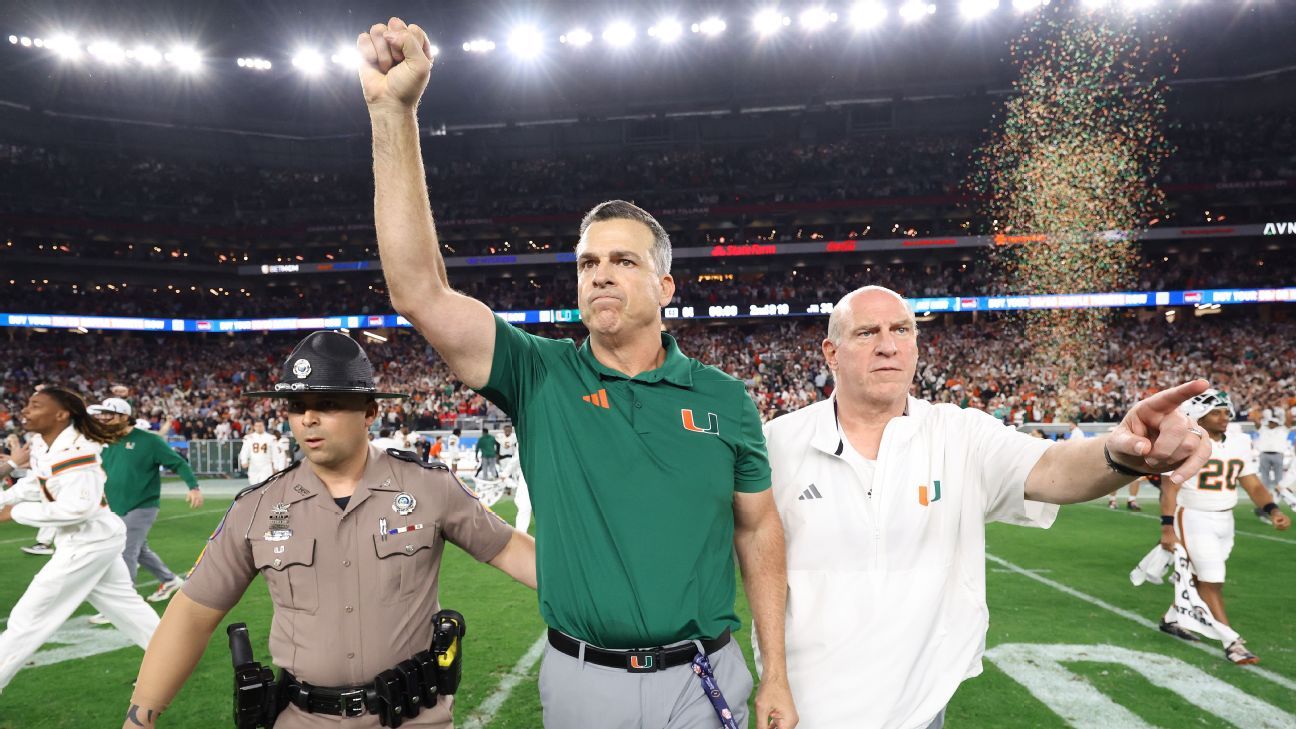
MIAMI GARDENS, Fla. — Mario Cristobal sat in his office a few days after a humiliating loss to rival Florida State, nine games into his tenure as Miami head coach in 2022, the walls around him still sparse because who has time to decorate when so much else needs to be done.
Already that season, the Hurricanes had unceremoniously lost to Middle Tennessee and Duke. More losses would follow.
“These are good pools of fuel for me because I don’t get down. I get pissed and determined to use it in a healthy productive manner,” Cristobal said at the time. “I feel the obligation to get Miami right. Call it a labor of love. I’m going to work myself to the grave to get this done.”
Three years and two months later, Cristobal stands on the precipice of delivering on the vision he sold when he took over the program: to restore the Hurricanes to their rightful spot atop the college football world, built with a blueprint Jimmy Johnson laid out when Cristobal committed to play at Miami in the late 1980s, then reinforced over the course of his own coaching career.
No gimmicks. No “hocus-pocus,” as Cristobal says.
“Within our group, as soon as he got here, we knew there wasn’t ever a doubt,” said his older brother, Luis, who also played at Miami. “It was going to be a matter of time before Mario was playing for a national championship. Because everybody knows he’s the type of guy that, if he puts his mind to anything, it’s a done deal. It’s going to happen.”
The road, of course, has not been smooth. Cristobal has weathered significant criticism throughout his tenure. During his four years at the helm, his Hurricanes have lost six times as a double-digit favorite. And when Miami lost to SMU in November, its second loss this season to an unranked team, all of that baggage started to get heavier.
His wife, Jessica, said she received nasty text messages about her husband following that loss, one that threatened to keep Miami out of the College Football Playoff. But Cristobal used the loss — and the onslaught of criticism — to galvanize his team. He went to the playbook that all the greats use. He told his players nobody wanted to see Miami win; that they had an opportunity to prove their “haters” wrong. Miami reeled off seven straight wins — including two in the CFP as an underdog — and now gets to play at home for a chance to win the sixth national championship in school history against Indiana on Monday night (7:30 p.m. ET, ESPN).
The story of this season might have started last January, but the story of this Miami Hurricanes era began five decades earlier, in a home off Southwest 67th Street, less than 4 miles from the University of Miami campus.
LUIS AND MARIO Cristobal were born in Miami to immigrant parents from Cuba who raised their sons with core values that revolved around hard work. Their dad, Luis Sr., owned a shop in Hialeah that sold car batteries, and their mom, Clara, worked for more than 30 years at Kendall Toyota. Luis says both parents worked “themselves to the bone” to provide for their kids. His maternal grandfather, a Cuban exile, learned how to build houses when he got to the United States and built the Cristobal home in the 1970s.
If the boys wanted some spending money, they would have to earn it — selling scrap metal from their dad’s shop as teenagers to make a couple of extra bucks.
Although they loved football — Cristobal was a die-hard Pittsburgh Steelers fan growing up — he and Luis were not allowed to play, for fear they would get hurt. Instead, their parents enrolled them in judo and baseball, the two most popular sports in Cuba.
When Luis was a sophomore at Columbus High, the football coaches took one look at him and decided he would make a perfect offensive lineman. His parents relented and let both of their sons play. It quickly became clear that the Cristobal boys had a knack for the game, and earning scholarships to the University of Miami became their goal. The program had captivated them as young boys, when they would get free tickets through the parks and recreation department in Miami-Dade County and ride the bus to the Orange Bowl, sit in the upper deck and watch in awe in the late 1970s and early 1980s — just before Howard Schnellenberger transformed the entire program with the first national title at Miami in 1983.
Mario Cristobal recalls watching the game that won the Canes that championship, a 31-30 victory over No. 1 Nebraska in the 1984 Orange Bowl.
“I remember my grandfather’s TV was going in and out, the wire antenna, black and white and fuzzy, in and out,” Cristobal said. “Nebraska scoring at the end and going for two, and Miami winning. Next thing I know, there’s cars and horns and pots and pans clanging all over the city of Miami.”
From that point on, the boys would often sneak out of the house, ride their bikes or sometimes hitchhike to get to Miami practice. “I was like, man, ‘I want to be one of those dogs. I want to be a University of Miami Hurricane,’” Mario said.
Luis, two years older, tells the story of then-coach Jimmy Johnson sitting in their living room with offensive coordinator Gary Stevens. “They offered, and I committed on the spot,” Luis said. “I had offers to go to Ivy League schools and my parents were just looking at me like, ‘Do you want to talk about this?’ I was like, ‘Nope.’ It was the same for Mario. When that dream became a reality for both of us, it was a special moment.’”
Johnson recruited Mario, but he played for Dennis Erickson after Johnson left for the Dallas Cowboys. Those days shaped him and made him. The brothers played on the offensive line — Mario the more decorated of the pair.
“I was a nobody on an unbelievable team with insanely good Hall of Fame teammates,” Mario Cristobal said. “But the experience itself was an absolute game-changer for myself and my mentality. It shaped my DNA, everything that I believe in. My entire belief system was shaped and molded by what I learned during that time.”
Cristobal won two national titles at Miami in 1989 and 1991, and he was an All-Big East selection in 1992, a time that ultimately transformed his life.
He knew he owed a debt to Miami.
CRISTOBAL STARTED HIS coaching career as a graduate assistant at Miami in 1998, famously telling then-coach Butch Davis that one day he hoped to be the Miami head coach. At the time, the Hurricanes had lost their way following NCAA sanctions that cut 24 scholarships over a two-year period. Miami went 5-7 in 1997, and Cristobal had a front-row seat to watch Davis rebuild the program. Though Cristobal had his big football dreams, he had applied to join the Secret Service and got a message while Miami was at the Gator Bowl in 1999 that he had made it. Cristobal said goodbye and packed up the two drawers he had in the office.
That night, he woke up in a panic at 4 a.m. What was he doing? Why was he walking away from the sport he loved?
“I got cut as an undrafted free agent, and it was devastating,” Cristobal said. “I had found another avenue to football, and I absolutely loved it. I loved teaching, I loved coaching, I loved being part of it again. I didn’t want to be without it, so I went back and begged for my $2 an hour job and they took me back.”
His winding road to the Miami job first took him to another school in Miami — Florida International, in its infancy as an FBS program. When Cristobal played at Miami, FIU was largely known as a commuter school in South Florida, with zero need for a football program. But the appeal to add football grew, and FIU launched its program in 2004 under former Dolphins quarterback Don Strock.
FIU went 0-12 the year before Cristobal took over in 2007, his first job as a head coach. What he found was a program also reeling from NCAA sanctions and under-construction facilities that forced the staff to work out of trailers. Cristobal recalls multiple times when bills weren’t paid and the team was left stranded without transportation to games — including once when the coaching staff and players had to carpool to get to the Orange Bowl, where FIU also played its home games.
Cristobal rolled up his sleeves. It was slow going in Year 1. FIU opened 0-11 and played North Texas in the season finale at the Orange Bowl, where the Panthers would play the final football game at the iconic stadium before its demolition. Improbably, FIU beat North Texas 38-19. Though Cristobal was wearing different school colors, getting that last win inside the stadium that delivered some of the best moments of his life felt like a cosmic message.
He still has pieces of turf from the stadium that night.
“It looked like a Super Bowl celebration with the school president popping champagne bottles,” Cristobal said. “You never say you’ve seen it all, but we’ve seen so much.”
Cristobal made the program into a winner, delivering the first two bowl appearances in school history — including the first bowl victory in 2010. Cristobal spent six seasons at FIU but was fired following a 3-9 campaign in 2012. That moment served as a turning point.
“I swore I would never let that happen again at all costs, no matter what hours I had to work, the things I had to do, I was never going to let that happen again,” Cristobal said.
A month later, he took a job working for Nick Saban at Alabama. The four seasons he spent there as assistant head coach, offensive line coach and recruiting coordinator reinforced the core tenets in which he wholeheartedly believed: Work hard, make no excuses and build teams through toughness and competition — starting along the offensive and defensive lines.
“That time with Nick Saban more than anything proved that Jimmy Johnson’s processes were on point. The principles of discipline, effort and toughness,” Cristobal said.
Those years prepared him to be the head coach at Oregon, where he turned a flailing program into a Rose Bowl champion in two seasons. But they also prepared him for the most important job of his life.
MIAMI FELL INTO mediocrity following its decades of dominance, cycling through four head coaches over 15 years after Larry Coker — who delivered the last national title in 2001 — was fired in 2006. Finally, in 2021, the school grew serious about making a financial commitment to football. That meant school officials could finally go after the one coach their alums and fan base had always had atop their wish list.
Cristobal had a dream job at Oregon, but it bothered him to see how far Miami had fallen. The debt he felt he owed to Miami? His heart told him to go. But before he did, he had a conversation with his wife that started with one simple question.
“‘Do you understand this will consume my entire existence?’” Cristobal said to her. “Miami has lost its way. We are the ones to help it find its way back. Miami is going to hold up that trophy again.”
Recalling that conversation after the CFP semifinal win over Ole Miss, Jessica Cristobal said, “This is his entire life’s dream, to get to this point. And he was right. It has taken every ounce of his effort and time. But I am willing to do whatever it takes to support what our dreams are, and we’re here. It’s just incredible.”
Cristobal knew there would be early struggles, but he also said, “We are going to dig this thing through the painfulness of setting a foundation the right way.”
Five players remain from his first recruiting class, in 2022, a group that went 5-7 in that first year.
“After that 5-7 season, I was walking through that locker room crying, and I went to Mario, and I said, ‘I just want to win, coach. That’s all I want to do,’” said senior linebacker Wesley Bissainthe, a part of that 2022 class. “Over the next few years, we just went to work, getting people that fit the culture. Everything else took care of itself.”
His incoming 2023 recruiting class featured Francis Mauigoa and Samson Okunlola — the two highest-rated offensive linemen in the country. They would be linchpins to his blueprint to build the trenches, so much so that when he was recruiting running back Mark Fletcher from Fort Lauderdale, Cristobal banked on one message.
“He told me that he was going to have big guys get people out the way for me, so that was one of the best things I could have heard as a running back,” Fletcher said.
But Fletcher was not immediately sold, committing instead to Ohio State. “I think I had 247 unreturned text messages to Mark Fletcher when he was committed to another school. So I’m glad we kept at it,” Cristobal said.
Hard work, toughness, resilience — the throughline never changed. Not even after an embarrassing 23-20 loss to Georgia Tech in 2023, when Miami opted against a kneel-down that would have secured a win. Instead, running back Don Chaney fumbled, setting off a chain of events that ended in a loss.
Not even after two losses in the final three games of 2024, when Miami could have had an ACC championship game and potential CFP appearance locked up with a win at Syracuse in the regular-season finale. Instead, Miami blew a 21-0 lead and lost, despite having eventual No. 1 pick Cam Ward at quarterback.
Losses like that only fueled a narrative that followed Cristobal from Oregon, one that criticized him for not being a strong in-game coach, and for finding ways to lose games to overmatched opponents. Fair or not, that narrative cropped up every time Miami lost as a favorite.
“Leadership is about continuous improvement in pursuit of excellence,” University of Miami president Joe Echevarria said after the Fiesta Bowl. “So we make some mistakes. Everybody makes mistakes, including me, but you just don’t make the same mistakes. Mario cut no corners. But he learned. When you’re the CEO of football, you learn. As someone who’s been a CEO, you make a lot of mistakes. As long as you get it right more than you get it wrong, it’s all good.”
IN THE EUPHORIA following a 10-3 win over Texas A&M in the first round of the playoff, Michael Irvin did something unexpected. That is saying something for the unpredictable former Miami wide receiver, whose theatrics on the Hurricanes’ sideline over the past two years have become must-see TV.
As Cristobal began his postgame interview, Irvin walked up to the coach and kissed him on the cheek. Miami alums everywhere might have wanted to do the same considering what has happened over the past 12 weeks. Losses to unranked Louisville and SMU brought out the same negativity that has often sunk Miami seasons. To make matters worse, former Miami coach Manny Diaz led Duke to the ACC title — after the Blue Devils won a tiebreaker over Miami to make it into the championship game.
But on Selection Sunday, Miami was the last squad to slide into the 12-team CFP field. Cristobal told his team that now it was the underdog, and the team embraced that message.
“Everybody was ready to jump on my coach had he lost that game after Manny had won,” Irvin said. “Everybody would have doused him with gasoline and set him on fire, so when you stand in that kind of pressure situation and you go in and facing 110,000 people yelling against you — you have to be prepared to withstand things, and he had that team prepared to withstand things. A lot of teams would have folded and given up, and this team did not.
“It was a kiss for the sacrifices the man has made. He had better opportunities, but this was home and he knew how much it meant to all of us, and he showed up for us. Man, that’s a godfather kiss. ‘Yes, godfather,’ I was saying to coach.”
The deep connection Miami’s football alumni have with the program has been strengthened with Cristobal at the helm. This past spring, almost 400 former players attended a reunion. Their presence throughout the playoffs has been constant, whether it is longtime mainstays Irvin, Lamar Thomas and Gino Torretta, or Ray Lewis, Andre Johnson, Reggie Wayne and Edgerrin James.
They all believe Miami needed one of their own to truly understand what it means to coach at Miami, build a program at Miami, and win at Miami.
“I tell people all the time, Miami is like its own nation,” said Darryl Jones, a receiver on the 2001 team who is the team chaplain. “I think it took a guy like Mario that understands that. He’s a tough dude, so he’s going to instill toughness, but to understand all those dynamics and to be able to put the right people, the coaching staff, the support staff and culture in place — it’s been amazing to see.”
Playing and coaching at Miami is not for everybody. Cristobal is demanding — a self-described “tough son of a b—-” — and his demeanor on the practice field and in games rarely wavers. Akheem Mesidor, who transferred to Miami in 2022 from West Virginia, was asked to describe Cristobal’s intensity.
“I can’t describe it with a word. I can give you a scale level,” he said.
And that is?
“Ten out of ten.”
Cristobal has been tight-lipped this week about the opportunity to win a national championship at his alma mater, in Miami, the only place that will ever feel like home. For him, there is a process to follow, and thinking too far ahead will only distract from what must be done Monday night: Winning the next game. It just so happens that next game is against No. 1 and undefeated Indiana, at Hard Rock Stadium, with the weight of Miami Hurricanes football atop his shoulders.
A former lineman, Cristobal knows what it means to carry a heavy load. He has done that for four years now. But there is a chance now to ease the burden — if only for a day — to call himself a champion again, in the place that made him one for the first time nearly four decades ago.
“This is way long overdue, right?” Reggie Wayne said amid confetti falling in Arizona. “Way long overdue for it to be a great storybook ending with an opportunity to win it at home. You couldn’t ask for anything better than that.”
By Andrea Adelson
Source link