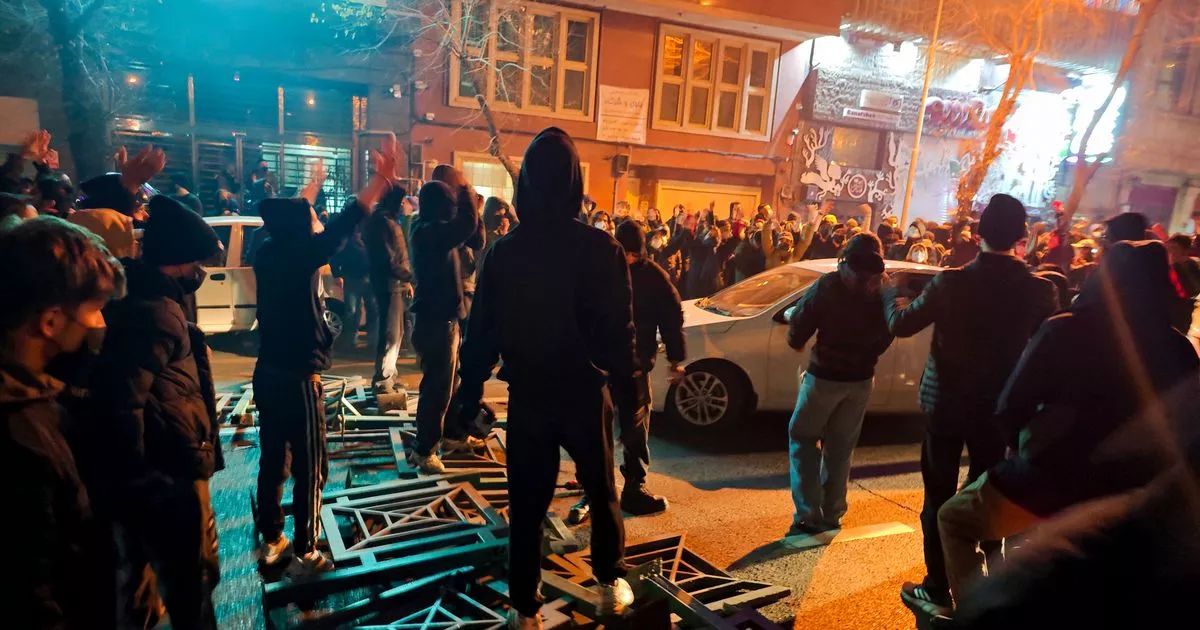
An expert has revealed the terrifying reality of life inside Iran as the internet blackout continues. From families searching body bags to no access to health care and street executions, the human rights specialist has issued an urgent plea
Violent unrest in Iran has reached new heights with a terrifying internet shutdown, thousands of protestors dead and one demonstrator set to be hanged. And now a human rights researcher and expert in Iran’s political climate has explained exactly what the blackout looks like for citizens on the ground – and the loved ones who can’t reach them.
Cut off from friends and family – with many Iranians in the diaspora fearing the worst – the world has laid in wait for six days as citizens face deadly violence and chaos. At least 2,000 people have died in protests so far, Iran officials have admitted. The horrific death toll estimate comes amid reports of street executions, troops shooting into crowds and people bludgeoned to death with police rifle butts.
Widespread anti-government protests erupted in the country last week, marking the biggest challenge to Iran’s regime in years. A brutal crackdown by security forces followed, with internet access cut off and body bags piling high on the streets. Erfan Soltani, one of the demonstrators speaking out, is set to be the first protestor to be hanged by the regime today – with no lawyer in sight. Others killed include Rubina Aminian, a 23-year-old fashion student who was shot to death as authorities began their crackdown on January 8. She was killed after exiting Tehran’s Shariati College to join the crowds.
READ MORE: Donald Trump tells Iranian protesters ‘help is on the way’ amid US attack fears
Speaking with The Guardian via text message, 25-year-old artist Maryam, who was present at protests in Tehran in the early hours of Friday, January 9, said: “They’re aiming for the eyes.” She added: “The Faraja [uniformed police], the Basij [paramilitary militia] and even plainclothes kill squads are driving into the crowds with motorbikes. I don’t know how long the internet will be working, but we are thousands on the streets, and I fear I will wake up to hundreds of casualties.”
Now facing US intervention and the possibility of strikes sanctioned by President Donald Trump, Amnesty International is pleading for an end to the blanket blackout. Researcher Rebecca White claims: “The Iranian authorities have once again deliberately blocked internet access to hide the true extent of the grave human rights violations and crimes under international law they are carrying out”.
More horror unfolded overnight in response to nationwide protests against Iran’s Supreme Leader Ayatollah Ali Khamenei – numbers not seen since the Woman Life Freedom uprising in 2022. Introduced on January 8, the internet blackout, according to campaigners, is designed to disguise crimes against international law.
Speaking exclusively to the Mirror, White explains: “Access to the internet is a crucial enabler of a whole host of human rights. Deliberately blocking internet access, as has been the case now in Iran for over 100 hours, denies access to those rights, and is a serious human rights violation in itself. The blanket shutdown, while not surprising, will have devastating and potential deadly consequences“.
White continues: “The consequences of a communications blackout like this are catastrophic for the people of Iran. In times of political crisis like this, access to internet and phone networks can be literally life-saving”. The expert shared that this “can and will be blocking information about emergency medical care; safe places or safe routes; access to financial services; and crucial information about the protests”.
Not only is this a physical barrier in the lives of Iranians, but may have detrimental effects on their mental health. White highlighted that “people, both in and outside of the country, have no way of knowing if their loves ones are safe. Of course, it also impedes fact-finding — people inside the country can’t share what’s going on with each other or the outside world, so vital documentation of abuses is being missed.”
White went on, saying: “At this stage, Amnesty’s focus is on gathering and verifying information about what’s happening, and this is being made exponentially more difficult due to the shutdown. This is entirely intentional. What do you you do if you want to brutally squash mass protests and avoid scrutiny and accountability? Turn the lights off [immediately]”.
Following news of Erfan Soltani’s planned execution, White declared: “There are horrors unfolding under the cover of digital darkness. In the last few days, Amnesty has verified videos showing families of protesters looking for their loved ones among body bags in a morgue in the Tehran province — but again, it goes without saying that getting access to this kind of crucial documentation is so much harder in a communications blackout. And that’s the point”.
White confirmed that “we’re seeing a climate of systemic impunity in Iran, and we have for a long time now. Amnesty has previously documented crimes under international law, committed by the Iranian authorities including: murder, torture, rape, and enforced disappearances, as a way to crush dissenting voices”.
She concluded: “There’s no doubt that blanket internet shutdowns can hide crimes and serious human rights violations, and also hide evidence of these crimes, as we saw in Iran in 2019. Recalling that “hundreds of people were killed in just five days of protests,” the Amnesty advocate said: “Our investigation, published in May 2020, found that more than 237 of these deaths took place within 48 hours of that internet shutting down”.
Meanwhile, campaign group Article 19 say of the current bloodshed in Iran: “Reports continue to emerge of the security services’ widespread use of lethal force and indiscriminate killings. Authorities have repeatedly opened fire directly at peaceful protesters, with eyewitnesses describing people being shot from behind at close range.
“In many cities, hospitals have become overwhelmed, as medics struggle to treat those with severe injuries from gunshot wounds. Last week, security forces raided the Imam Khomeini Hospital in Ilam, deploying teargas and beating patients, their families, and medical personnel while attempting to arrest the injured protesters and seize the bodies of those killed.”
White said that the ‘tactful’ shutdown is “by no means a new one”. Listing previous goverment shutdowns done by authorities in “Sudan, Afghanistan, Pakistan, Belarus, Mynamar, India — to name just a handful,” the expert labelled this as “just one of many tools of repression”.
“They often take place during armed conflict, elections and, as we’re seeing now, times of mass protest. Let’s be clear: total shutdowns like this are always an attack on human rights. Numerous courts have ruled them unlawful. They’re inherently disproportionate under international human rights law. They should never be imposed and can never be justified,” she said.
Iran’s Supreme Leader Ayatollah Ali Khamenei, in a statement carried by state TV, praised the tens of thousands who he claimed took part in pro-government demonstrations nationwide on Monday. He said: “This was a warning to American politicians to stop their deceit and not rely on traitorous mercenaries. The Iranian nation is strong and powerful and aware of the enemy.”
State TV on Monday aired chants from the crowd, which appeared in the tens of thousands, of “Death to America!” and “Death to Israel!” Others cried out, “Death to the enemies of God!” Iran’s attorney general has warned that anyone taking part in protests will be considered an “enemy of God,” a death-penalty charge.
Trump declared on Monday that countries doing business with Iran will face 25% tariffs from the United States. He said the tariffs were “effective immediately.” And today, the president cancelled his talks with Iranian officials and told protesters: “Help is on its way.”
He said earlier this week that Iran wanted to negotiate with Washington after his threat to strike the Islamic Republic that has killed more than 2,000, according to human right monitors. In a morning post, Trump, 79, urged demonstrators to “keep protesting” as he threatened “killers and abusers” they “will pay a big price.”
He posted: “Iranian Patriots, KEEP PROTESTING – TAKE OVER YOUR INSTITUTIONS!!! Save the names of the killers and abusers. They will pay a big price. I have cancelled all meetings with Iranian Officials until the senseless killing of protesters STOPS. HELP IS ON ITS WAY.”
The US president has repeatedly threatened Tehran with military action if his administration found the Islamic Republic was using deadly force against anti-government protesters. Trump on Sunday told reporters he believed Iran is “starting to cross” that line and has left him and his national security team weighing “very strong options” even as he said the Iranians had made outreach efforts to the US.
On Monday, however, the president’s team offered guarded hope that diplomatic solution could be found. White House press secretary Karoline Leavitt told reporters: “What you’re hearing publicly from the Iranian regime is quite different from the messages the administration is receiving privately, and I think the president has an interest in exploring those messages. However, with that said, the president has shown he’s unafraid to use military options if and when he deems necessary, and nobody knows that better than Iran.”
READ MORE: UK special forces poised to storm Russian ‘shadow fleet’ tankersREAD MORE: Iran air strikes loom as US citizens warned to leave country in turmoil NOW
By
Source link